
Bali starling conservation · Indonesia
Let the birdsong return.
A white bird with a flash of blue around its eyes came close to disappearing from the wild. On the islands off Bali, its return has depended on a remarkable agreement: whole communities choosing to protect it.
Get expedition dates and application openings by email.
Dates coming soon · Limited places · Application only
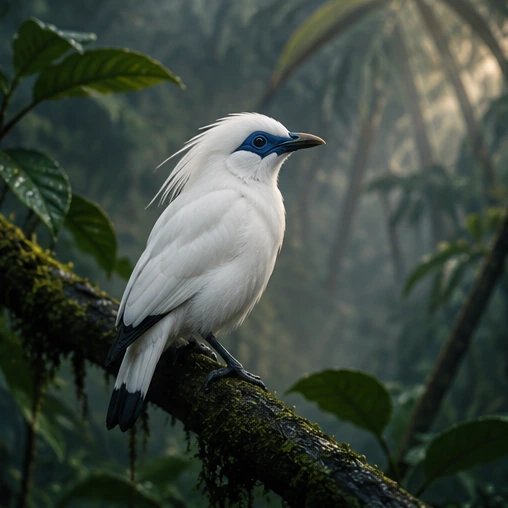
Illustrative species image · From the supplied Wild & Kind design.
Too beautiful for its own survival.
The Bali starling belongs to this small corner of the world. Its white plumage and vivid blue eye patches also made it a target for the cage-bird trade. By the time a new island conservation effort began in 2006, fewer than ten were reported to remain in the wild after decades of trafficking.
Breeding birds for release could help rebuild their numbers, but it could not, on its own, keep them safe once they were flying free. A released starling still needed somewhere to feed and nest, and protection from the people who might capture it. Its future would depend on what happened beyond the breeding centre.
A promise made village by village.
On islands off Bali’s coast, conservationists worked with local communities to make bird protection part of traditional village rules. The agreement gave endangered birds a refuge that extended across the places where people lived, worshipped and worked. Residents became the birds’ protectors against poaching and trafficking.
Local faith became part of their return. Birds have been released with prayers and blessings at temple ceremonies, and nest boxes placed in nearby trees to help them breed safely. A starling settling into one of those boxes carries years of effort with it: the keepers who raised it, the people who made room for it and the community that agreed it should remain free.
The work follows them into the trees.
After the birds take flight, the team continues to follow their lives: where they settle, what they eat and whether they breed. Nest boxes need to be built, installed and monitored. Restoring habitat gives the birds more places to find food and shelter as their range grows.
The wider effort includes tree nurseries, saplings for local families, conservation education and scholarships for young people. That connection matters on an inhabited island, where land must sustain households as well as wildlife. A bird can be bred in a centre and released in a moment; the conditions that allow its chicks to grow up wild have to be cared for over years. This is the part of the story we want to bring people into.
The expedition
Meet the people behind the return.
The expedition will follow the relationship between native birds, their habitat and the communities protecting them. We want guests to understand the care that continues after release and contribute to the local team’s priorities. Time spent learning how that work fits into island life is as much a part of the experience as the birds themselves.
Dates coming soon. Join the waitlist to hear when applications open.
Dates coming soon · Limited places · Application only
Join the
waitlist.
Join the waitlist for Bali. We’ll email you when dates are announced and applications open.
Places on every expedition will be very limited. All places are offered by application.
Joining the waitlist does not reserve a place.